Piazza del Popolo
Back to all places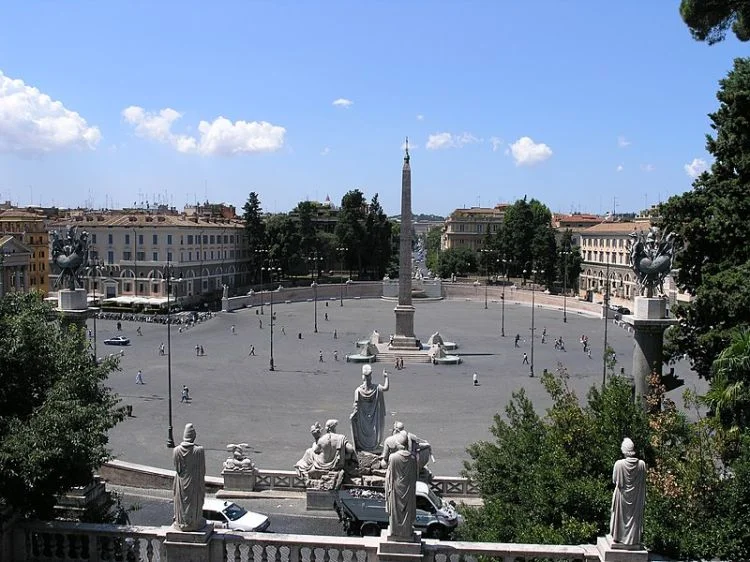
The Corso emerges onto the splendid oval Piazza del Popolo (“People’s Square”), which is monumental without being intimidating. Over a period of 300 years, it was constructed as the ceremonial entryway to Rome, and, although its elements are diverse in style and in age (13th century BCE–19th century CE), a remarkable harmony prevails. In 1561 the Porta del Popolo, the medieval gate in the city wall, was rebuilt. Ninety-four years later its inner face was redone by Bernini for the grand entrance of Queen Christina, who had abandoned the Protestant throne of Sweden for the hospitality of Catholic Rome. In 1589 Pope Sixtus V punctuated the piazza’s centre with an obelisk (13th century BCE) brought by the emperor Augustus from Heliopolis in Egypt to the Circus Maximus.
The church next to the gate, Santa Maria del Popolo, which stood for centuries before the piazza existed and gives its name to the area, was founded in 1227 to replace a 1099 chapel built over what was presumed to be the emperor Nero’s tomb. It was replaced in 1472–77 by the present-day church, further disguised on the piazza frontage by a Neoclassical facade. The interior is fraught with the works of great Renaissance and Baroque artists. The main chapel has tombs by Andrea Sansovino and frescoes by Pinturicchio. In the Cerasi Chapel are Caravaggio’s The Conversion of St. Paul and The Crucifixion of St. Peter. The Chigi Chapel, unique for the early 16th century in being a miniature church, was designed by Raphael. Bernini sculpted two of the four prophets in the corners.
At the opposite end of the piazza stand “twin” churches (1662) framing the entrance to three streets. The streets were there first, so the churches were ingeniously squeezed into awkward, different-sized plots between them. Santa Maria in Montesanto, on the east, has an oval plan and dome, while Santa Maria dei Miracoli, on the narrower plot toward the Tiber on the west, has a round dome. Carlo Rainaldi, the architect, turned both facades slightly inward to frame the welcoming parades that would proceed up the Corso between the two churches. One of the streets, the Via del Babuino, was one of many built by Sixtus V.
https://www.britannica.com/place/Rome/Piazza-del-Popolo
Photo: WolfgangM
41.91070, 12.47636